Tag Archives: hard

Puzzles 107, 108: Hochhausblöcke

To make it a full two weeks of post-LM posts, here are two more Hochhausblöcke. One with the maximal number of givens, one with the minimal number. (There are some more of each, but these are the nicer ones. The minimal one requires a well-placed deep case distinction, or I do at least.)
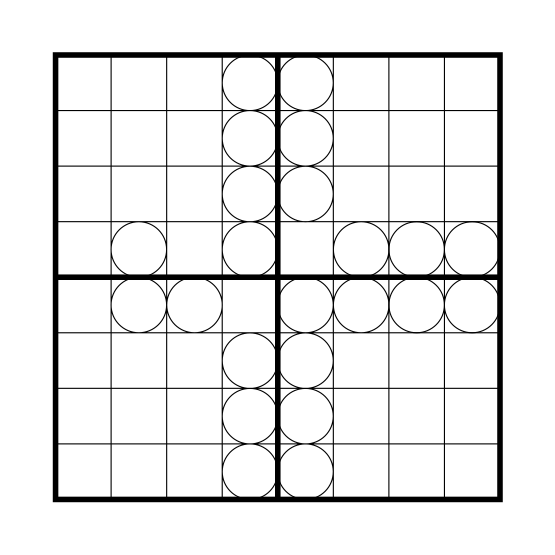
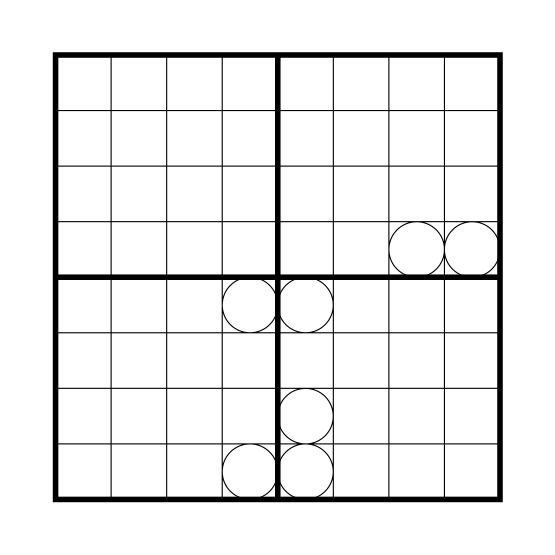
hochhausblock-max hochhausblock-min

Rules Place numbers from 1 to 4 in each cell so that each row and column of each 4×4-block contains all numbers 1 to 4. Circled numbers are valid skyscraper clues for the adjacent grid (for both adjacent grids in the central corners). Uncircled numbers are not valid skyscraper clues for the adjacent grid (for neither adjacent grid in the central corners).

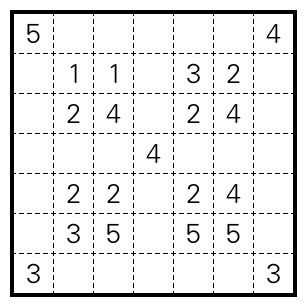
Puzzle 106: Pentowords

We’re reaching the end of the series of LM practice puzzles. Pentowords is an interesting new (to me) type that was also on the mixed round. The one on the contest was built around a letter packing argument (though I only half saw that while solving), this one is quite different.

pentowords

Rules Split the grid into the twelve different pentominos, and write each of the given words into one of the pentominos, left to right then top to bottom. Same letters must not touch by edge. Some letters are already given.

Puzzle 104: Keller, Japanese Sums+Dotted Snake

Last of the Kellers, and the hardest. You really can’t say I wasn’t prepared.

japsum-keller

Rules The left grid is a Japanese Sums puzzle, digits 1-8. Place digits in some cells, so that they don’t repeat in rows or columns. Clues give the sums of blocks of adjacent digits in order. The right grid is a Dotted Snake: Draw a snake of any length that occupies full cells and doesn’t touch itself, not even diagonally. Numbering the snake cells from head to tail, put a dot in every third cell, starting with the third. Clues indicated the number of dotted snake cells in the corresponding row or column.

The grids interact: There must be a digit under every snake cell, and that digit must be divisible by three if and only if the corresponding snake cell is dotted.

Puzzle 93b: Regular Tapa

I thought the underlying “regular” Tapa from the JaTaHoKu I published earlier was worthy of a dedicated post. Is there a name around for this variant?

While resolving this one will require a few case distinctions, it does have a reasonable break-in, and is quite doable if you choose the right spots. It’s possible that prescribing the number of shaded cells is not necessary, give it a try with three shaded cells per row/column.

tapa-regular

Rules Solve as a regular Tapa. Additionally, there must be exactly four shaded cells in every row and column.

Puzzle 98: JaTaHoKu, cryptic

Last JaTaHoKu for now, a JaTaHoKu with cryptic clues. I made a triagonal one, too, but didn’t get around to rendering that yet. Maybe later.

jatahoku1-6crypt

Rules Place numbers from 1 to 6 into some empty cells, such that each row, column and region contains each number exactly once. Clues within the grid are Tapa clues; the numbered cells form a valid Tapa solution with respect to these. Clues along the bottom and right edges are skyscraper clues. Clues along the top and left are Japanese Sums clues, with question marks standing in for unspecified digits. (I.e., 10 would be two question marks.)

Some digits have been replaced by letters. Equal letters correspond to equal digits, different letters to different digits.

Puzzle 97: JaTaHoKu, cylindrical

Another JaTaHoKu, this time cylindrical.

jatahoku1-5cylinder

Rules Place numbers from 1 to 5 into some empty cells, such that each row, column and region contains each number exactly once. Clues within the grid are Tapa clues; the numbered cells form a valid Tapa solution with respect to these. Clues along the bottom and right edges are skyscraper clues. Clues along the top and left are Japanese Sums clues, with question marks standing in for unspecified digits. (I.e., 10 would be two question marks.)

The grid wraps around from top to bottom. Clues along the top act as Japanese Sums clues in order, starting at any group of numbers. Clues along the bottom act as Skyscraper clues, starting at 1. (So for example, a clue ‘1’ is impossible.)

Puzzle 95: JaTaHoKu

Another JaTaHoKu, this one using the full rule set. It’s probably a bit easier than the first one. Note that the given 4s in the grid are Tapa clues.

jatahoku1-5

Rules Place numbers from 1 to 5 into some empty cells, such that each row, column and region contains each number exactly once. Clues within the grid are Tapa clues; the numbered cells form a valid Tapa solution with respect to these. Clues along the bottom and right edges are skyscraper clues. Clues along the top and left are Japanese Sums clues, with question marks standing in for unspecified digits. (I.e., 10 would be two question marks.)

Puzzle 93: JaTaHoKu

Here’s a first (Ja)TaHoKu, which I made to prepare for the Logic Masters. Mostly an exercise in the interaction between the Tapa rules and the equal number of cells per row/column/region; that part seems to have potential as a Tapa variation. Would you have thought that even without rooms, the one Tapa clue implies that the mirrored cell has to be shaded?

jatahoku1-4

Rules Place numbers from 1 to 4 into some cells, such that each row, column and region contains each number exactly once. Clues within the grid are Tapa clues; the numbered cells form a valid Tapa solution with respect to these. Clues along the bottom and right edges are skyscraper clues.

Puzzle 91b: Maxi Loop

I noticed that the argument I had in mind didn’t work out quite as intended in the previous Maxi Loop, here’s an updated version.maxiloop1b

Rules Draw a single closed loop that connects cell centres horizontally and vertically, visiting every cell. Clues indicate the length of the longest loop segment in that room.