This is a Cave puzzle.

This is a Cave puzzle.
A second symmetric LITS. As before, solve as LITS, such that the shaded cells are symmetric around the centre.

Here’s some broken train stations to celebrate placing first in the recent Bahnhöfe series on CrocoPuzzle.

Rules Blacken one of each pair of identical numbers, then solve as a regular Bahnhöfe puzzle: Draw a loop that visits every cell (except the blackened stations), travelling vertically and horizontally. The loop crosses itself at the cells marked ‘+’, and can not touch itself otherwise. The loop goes straight through each (unblackened) number, and visits them in order.
There’s an example on the wiki.
Here’s a LITS puzzle, with the extra constraint that the solution must have 180º rotational symmetry around the centre. I wouldn’t be surprised at all if this had been done before.

Here’s two quick Geradeweg puzzles.


Guess I had skyscrapers on my mind after batch-solving the first week of Roland Voigt’s daily puzzles. No, it doesn’t solve as a tightfit skyscraper puzzle.

Rules Place a number between 1 and 6 in each cell (one in each triangle for divided cells) such that each row and each column contains every number from 1 to 6 once. Reading the divided squares as fractions, the numbers in the squares represent the heights of skyscrapers. Clues outside the grid indicate the number of skyscrapers that can be seen when looking into the corresponding row or column. Skyscrapers block the view to any other skyscrapers of smaller or equal height behind them.

Example
Here’s another one from the LM preparation. EDIT: new version fixing an ambiguity.

Rules Shade some cells, such that there’s at most one unshaded copy of any number within a row or column. Shaded cells must not share an edge. Then draw a single loop that travels horizontally and vertically between cell centres that visits all unshaded cells.
Saturday was the German Logic Masters in Stuttgart. I’m mostly happy with how it went, placing fifth after last year’s seventh in what was probably a stronger field. Though missing place four and thus the A-team for London by a single point is a bit hard.
The puzzles were great, I particularly enjoyed the “special” rounds, such as the Doppelter Rundweg or the final Vier Jahreszeiten. They’re available now as online contests.
I had a bit of time this year and made some puzzles in preparation that I’m going to post over the next couple of days. The first is a Sackbahnhöfe.

Rules (from the booklet) Draw a loop with some branches into the grid, which visits every field of the grid. The loop crosses itself only at the marked crossings. Fields with numbers are railway stations. The loop branches in the field before the railway station. There may be only one branch in a field. The branch then moves straight through the railway station, and ends in the field after it. The branches with the stations have to be in increasing order along the loop.
See the contest page for instructions that include an example.
Here’s a Hitori puzzle that I made a while back. Which gives me an excuse to advertise the German Logic Masters that take place in Stuttgart on Saturday, which include a Hitori-themed round among others. The instructions were published this weekend, it promises to be an excellent set of puzzles. What’s more, this year the contest will also be offered online with a slight delay, see this forum thread.

Here’s a “knapp daneben” pyramid puzzle, i.e., all clues are off by one. Please excuse the slight asymmetry, it’s because the bottom clues including gaps were meant to be transferred from other puzzles. It’s fall-out of a puzzle contest I’ve helped write, together with the Berlin Stammtisch, which will be held on the weekend of June 28. See the instruction booklet.
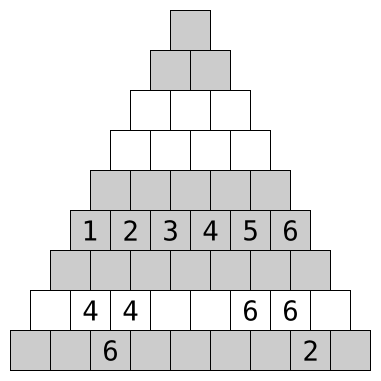
Rules Place a number from 1 to 9 in each cell, such that for any two horizontal neighbours, the number between and above the two is their sum or their difference. In gray rows, all numbers must be distinct, while in white rows, there must be at least one pair of duplicate numbers. All given numbers are off by one.
 Maybe Puzzles