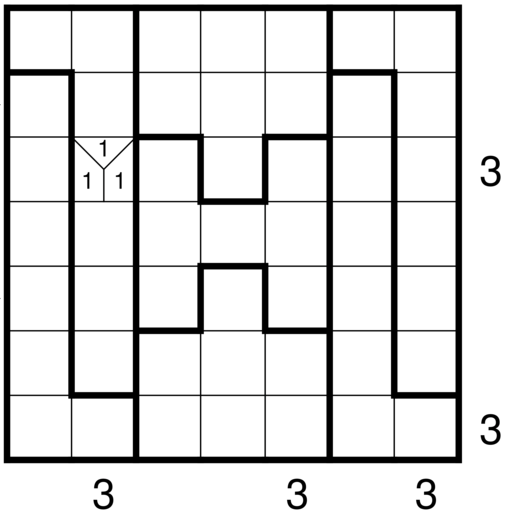
Back to the regular schedule, with another Maxi Loop.

Rules Draw a single closed loop that connects cell centres horizontally and vertically, visiting every cell. Clues indicate the length of the longest loop segment in that room.
Back to the regular schedule, with another Maxi Loop.
Rules Draw a single closed loop that connects cell centres horizontally and vertically, visiting every cell. Clues indicate the length of the longest loop segment in that room.
Next Keller puzzle. Some of the logic may have been lost in completing the domino part for this one. I find the restrictions that the compatible domino tiling imposes on the loop to be quite interesting in this type, the interaction with the domino puzzle as such less so.

Rules The left grid is a domino dissection puzzle. Divide the grid into 2×1-areas such that each domino occurs exactly once. The right grid is a standard fences/slitherlink.
The grids interact: Superimposed over the solved domino grid, the fence can’t bisect a domino.
Another break, this time for the series of Kellers. This one didn’t come out quite the way I wanted and could use a bit of polishing, but…

Rules Split the grid into areas of size 1, 2, 3 such that areas of equal size don’t touch along an edge, and such that any given number is contained in an area of that size. (I.e., Fillomino with areas of size at most 3.)
Another practice puzzle for the Keller round. This one has a wart, I messed up the sign on the break-in, and don’t see a nice way to fix it. This will have to do. I don’t remember whether it’s actually difficult, beyond the awkwardness of the type.
EDIT: Fixed an ambiguity, thanks uvo.

Rules The left grid is a Sternenhimmel. Place some stars in empty cells, such that every arrow points at at least one star, and such that every star is pointed at by at least one arrow. Clues outside the grid indicate the number of stars in the row or column. The right grid is a Magnets grid. Place + and – in some cells, such that every 2×1-plate is either completely empty/shaded (neutral), or has one + and one – (charged). Same signs can’t be adjacent.
The grids interact: Stars may only be placed over charged plates. Arrows over charged cells are rotated (90˚ clockwise for +, counterclockwise for -).
Hochhausblöcke is a neat skyscraper variant that showed up in the Rätselportal round. They’ve usually been less regular, but from the instructions it was clear that the one on the competition would be an 8×8-grid. I thought there was a good chance of a puzzle without outside clues, and certainly the interactions involved there need more practice, so I tried to construct such a puzzle. I kept running into dead ends, started doubting that they exist at all, and threw the computer at the problem. It turns out that there’s a lot, but they’re rare enough: there’s a good 200000 excluding symmetries, or a little under 1% of all clueless grids you could write down. It should not be unreasonable to find one by hand. Here’s one.
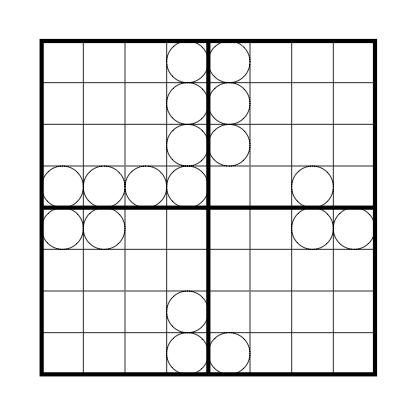
Rules Place numbers from 1 to 4 in each cell so that each row and column of each 4×4-block contains all numbers 1 to 4. Circled numbers are valid skyscraper clues for the adjacent grid (for both adjacent grids in the central corners). Uncircled numbers are not valid skyscraper clues for the adjacent grid (for neither adjacent grid in the central corners).
As a bit of a breather before posting more JaTaHoKus, here’s a puzzle for one of the new types, at least I hadn’t seen it before. It was on the mixed round of the Logic Masters. It’s an “edge and corner fences”.

Rules Draw a single loop consisting of vertical and horizontal segments between dots that does not touch or cross itself. Clue numbers indicate the number of adjacent edges and corners that are used by the loop.
Another JaTaHoKu I just made, to prove to myself that it’s possible to make accessible JaTaHoKus. You might want to solve this one before the previous one.
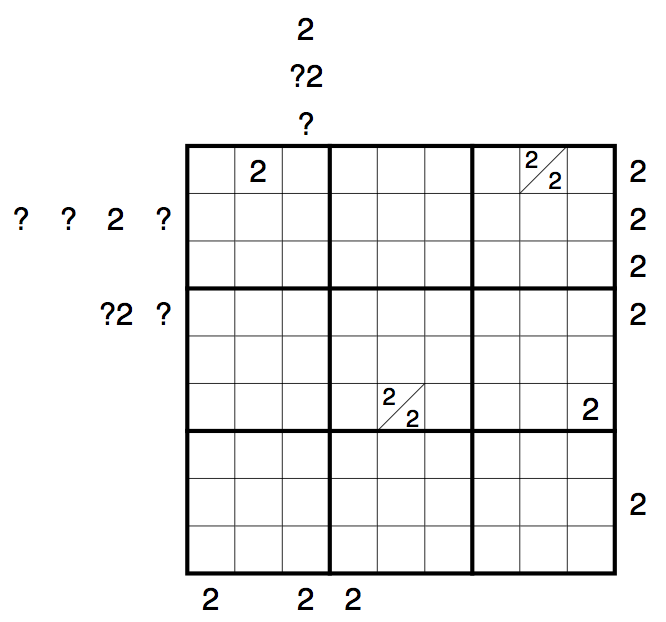
Rules Place numbers from 1 to 5 into some empty cells, such that each row, column and region contains each number exactly once. Clues within the grid are Tapa clues; the numbered cells form a valid Tapa solution with respect to these. Clues along the bottom and right edges are skyscraper clues. Clues along the top and left are Japanese Sums clues, with question marks standing in for unspecified digits. (I.e., 10 would be two question marks.)
Here’s a Transparent Kuromasu. Like the Horse Snake last week, this type occurred on Prasanna’s transparency-themed round at the Polish championships in back in April.
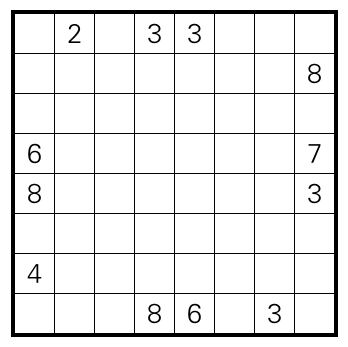
Rules Shade some cells, so that shaded cells don’t touch by edge, and such that all unshaded cells are connected by edge. Clues (which may be shaded) indicate the number of unshaded cells that can be seen in horizontal and vertical direction, including the clue cell.
Here’s a Checkered Fillomino, flowery theme.

One more Tom-tom puzzle. That’s it for the series.
Rules Fill the grid with digits 1-7, so that no digit repeats within a row or a column. (Digits may repeat within rooms.) Clues indicate the result of applying a basic operation (addition, subtraction, multiplication, division) to the digits within that room, starting with the largest digit.
Or see the instruction booklet.
 Maybe Puzzles