This is a Pentominous puzzle.
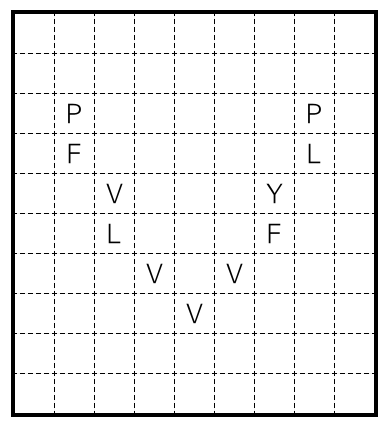
This is a Pentominous puzzle.
Here’s a practice puzzle I made for the German puzzle championships, which took place end of June. The puzzle is a Summawake, a variant of Heyawake that I haven’t seen before. I believed the competition puzzle (and the type) was due to Florian Kirch. It’s actually due to Ulrich Voigt! The instruction booklet has an example. 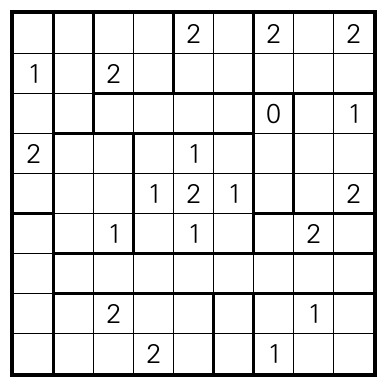 Rules Shade some cells, such that all unshaded cells are connected by edge, and that no two shaded cells share an edge. A horizontal or vertical stretch of unshaded cells may cross at most one area boundary. In addition, if there are any unshaded clues within an area, the number of shaded cells within that area must be equal to the sum of unshaded clues within that area.
I’ve made some star battle puzzles recently, for a series on croco-puzzle that’s starting today. Here’s one that turned out a bit hard. 3 stars.

Rules Place stars in some cells, such that each row, column and area contains exactly 3 stars. Cells with stars must not touch, not even diagonally.
Long time no post. I’ve been making puzzles for croco-puzzle recently, the ongoing Best of 24h series, in particular.
But, here’s a practice puzzle for the coming German GP round next weekend. It’s on the hard side — I’d be interested to hear if you find (a way around) the intended break-in.

Rules Shade some cells, and fill the remaining cells with digits from 0 to 6, such that no digit occurs more than once in each row or column. The numbers outside the grid indicate the sums of blocks of connected digits in the correct order. This includes single digits.
Example (digits 0-3)
This year’s 24 hour puzzle marathon is just over. Thanks to the organizers, authors and participants for a great weekend. I contributed a round again. It turned out a little less polished and balanced than last year’s, but there’s a couple of nice puzzles in there. Puzzles below, or grab a copy of the booklet.
Two more Checkered Fillominos. I made a bunch of them for the 24 hours that take place in Budapest this weekend. These here use some different logic. The first one turned out to have an easier break-in that circumvents what I had in mind, but maybe the similarities help as a hint?

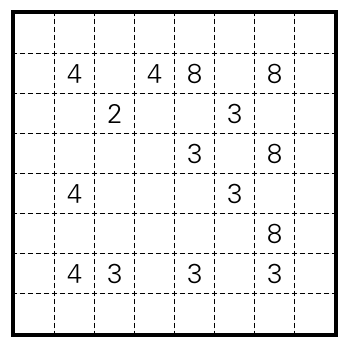
This is a Starwars puzzle, another of the types on the GP. Inspired by a certain puzzle on the portal. Rules Place stars in some cells, such that cells with stars don’t touch, not even diagonally, and such that each row, column, area and line has exactly two stars.
Here are two neighbors puzzles, a type which features on next weekend’s Dutch round of the WPF Puzzle GP. This time there is plenty of practice material, see Richard’s comment on the GP forum.
I made the second one first, but it appears I broke or imagined some of the logic. It does seem to have turned out unique. Usually I wouldn’t post it, but maybe it’s good practice for dealing with an impenetrable puzzle? If you find a nice way through, do let me know.


Rules Place a digit between 1 and 3 in every cell, such that each row and column contains exactly three copies of each. A cell is shaded if and only if the digit that it contains is different from all orthogonally adjacent digits.
I hope you enjoy these Checkered Fillominos as much as I do. This one came out clearly too hard for this year’s 24h puzzle championship in Budapest. (April 17-19, I don’t think it’s too late to join.)
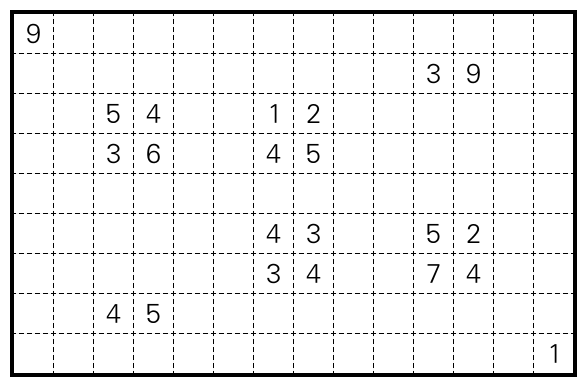
EDIT Fixed an amibiguity. (Hopefully. Thanks Prasanna for finding it.)
The German qualification is through. The puzzles will be available there again sooner or later, maybe I’ll post my contribution to the set here later. Here’s a somewhat trickier Checkered Fillomino that didn’t make it. I’m not sure it’s right to tag it as hard, that depends a lot on how well you know the type. 
 Maybe Puzzles